
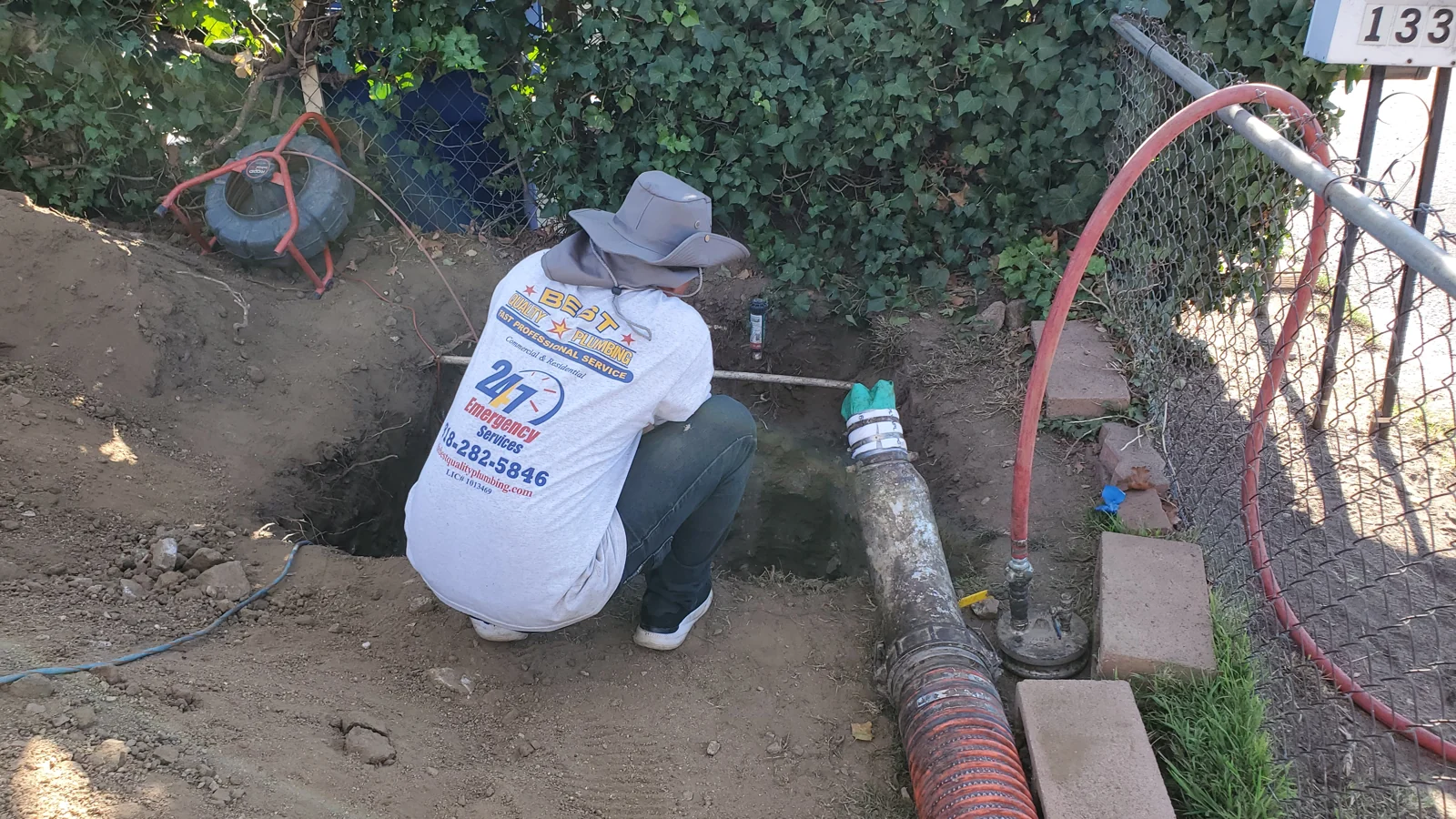
When a sewer line is damaged, the choice is not simply trenchless or not. Lining renews a pipe from inside, pipe bursting replaces it along the same path, and excavation opens the ground to repair or replace it directly. Each method suits different conditions, and an honest recommendation explains why one fits your line.
FIELD NOTE
Lining
A resin-saturated liner is installed through a cleanout or small access point and cured inside the old pipe. It suits a pipe with cracks, leaking joints, or root entry that still holds its shape.
It is not a fix for a collapsed, badly offset, or sagging section. The new pipe is slightly smaller inside, and branch connections are reopened after curing.
FIELD NOTE
Pipe Bursting
A bursting head is pulled through the old pipe and breaks it outward while a new pipe, commonly HDPE, is pulled in behind it. The work usually runs between an entry pit and a receiving pit.
It can replace a pipe that is too damaged to line. Soil, depth, pipe material, nearby utilities, and the route affect whether it is practical. Utilities are located through DigAlert (811) before any digging.
FIELD NOTE
Excavation
Traditional excavation opens the ground over the damaged section so it can be repaired or replaced directly. It is still the right choice for some lines, such as a short, shallow, easily reached defect, a sag that needs the slope corrected, or a route where trenchless methods are not suitable.
Whichever method is proposed, ask for the reason, the access involved, any permit requirements from the local building authority, and what surface restoration is or is not included.
Need Help With
Pipe Lining?
If this sounds like the problem you’re having, read about our pipe lining service or tell us what’s happening.
For urgent help, call (818) 282-5846